Why human-curated content is essential to provide chatbots with the right context
by Carsten Lambrecht, Senior PM Innovations & AI at Bookwire
The Shift from SEO to GEO
Over the past decade, digital discovery has transformed from simple search engine optimization (SEO) toward a new frontier: Generative Engine Optimization (GEO). While SEO focused on making content discoverable for search engines, GEO optimizes content for AI-powered chatbots and conversational platforms. The goal is no longer just clicks, but contextually relevant answers that guide users to the right products. For audiobooks, this shift opens a major opportunity: the right community-generated content can help AI systems recommend titles with trust, nuance, and real human insight.
What is GEO?
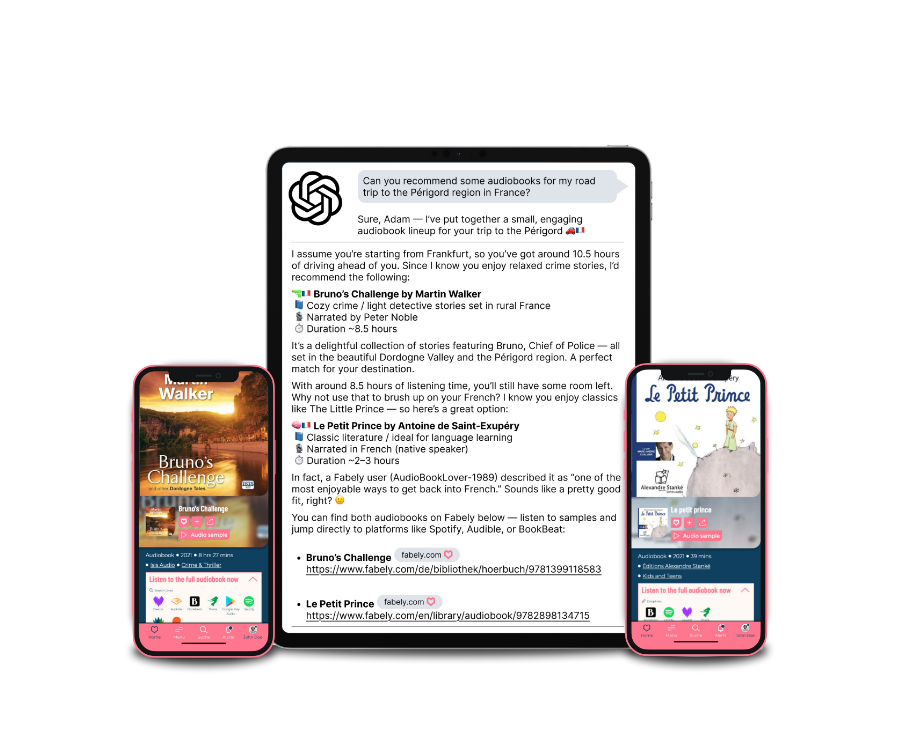
GEO, or Generative Engine Optimization, extends the principles of SEO by going beyond keywords. While SEO optimizes for factual search queries—think “audiobook” or “Cozy Crime”—GEO focuses on context. It prepares content to answer nuanced questions from users in conversational formats. For example: „Can you recommend a good audiobook for my trip to the French Atlantic coast?“ A traditional SEO approach cannot fully answer this. GEO, however, considers multiple layers of context: the user’s interests (topics and orgenres), location, travel time, preferred narrators, and even listening habits. It aims to deliver a recommendation that feels personal and trustworthy, not generic.
Why GEO is Critical Today
Chatbots are becoming smarter—and users lazier. Instead of crafting precise queries, they type brief, context-light questions expecting detailed, accurate answers. Here, GEO diverges from SEO: keywords and metadata alone are insufficient. What matters is layered, context-rich content that can be parsed by AI to infer intent. Quality and trust remain essential. For SEO, Google’s E-E-A-T framework (Experience, Expertise, Authoritativeness, Trustworthiness) guides content evaluation. GEO inherits these principles but demands additional depth: content must provide situational relevance and nuanced recommendations, not just factual accuracy. Content must be inherently citable. This shift from SEO to GEO therefore marks a move away from pure link building toward what can be described as “citation building”.
Lessons from Human Curation: Fabely as a GEO Case Study
The human touch is more critical than ever. In our earlier research on audiobook discovery, we observed that users prefer curated, contextualized recommendations. Viral trends work well for music, but not so much for audiobooks. Listeners invest time, attention, and emotional energy, so recommendations must feel trustworthy. Fabely applies this principle digitally. Users create lists, explain why titles match certain moods or situations, and share insights. This human-generated content is rich in context—exactly what GEO needs to deliver precise answers in conversational AI environments.
The Renaissance of User-Generated Content
For GEO, the quantity and quality of user-generated content (UGC) become pivotal. The more contextualized, trustworthy, and personally curated recommendations a platform collects, the better AI can answer complex, intent-driven queries. On Fabely, users create themed lists for specific contexts: learning a language (e.g., The Little Prince for Spanish learners), traveling in Spain or France, or engaging with social topics. This content helps chatbots suggest titles aligned with nuanced user intentions—far beyond generic keyword matches.
How Fabely Enables GEO Optimization
Fabely’s open community model, paired with gamification, encourages users to engage deeply with content. Listeners become fans, fans become contributors, and contributors enrich the platform with high-quality context. Features like following other users’ lists and push notifications keep content alive and continuously updated. From a GEO perspective, this creates a feedback loop: richer user-generated content improves AI understanding, which in turn drives better recommendations back to users, encouraging more contributions. Over time, Fabely becomes both a source of trustful recommendations and a data-rich context engine for chatbots.
Looking Ahead: Agentic AI and Audiobook Discovery
Some may wonder: if chatbots can eventually sell and recommend products directly, will platforms like Fabely become obsolete? Not for emotional products like books and audiobooks. Discovering and selecting these titles requires context and narrative understanding, not just transactional accuracy. The descriptive, curated content generated by communities remains vital. It ensures AI can provide thoughtful, situation-aware recommendations. Moreover, users discovering titles through a chat interface may then visit platforms like Fabely to explore lists, interact with communities, and generate new contextual content—creating a self-reinforcing cycle that benefits both humans and AI.
Technical Considerations for GEO
Delivering content for GEO requires structured, accessible formats that AI can interpret. Metadata alone is insufficient; natural-language context is key. Fabely has already implemented early use cases, integrating structured lists, reviews, and contextual annotations. Analytics show repeated visits originating from chatbots, validating the GEO potential of community-driven curation.
Conclusion: Context is King — and Publishers Should Shape It
The transition from SEO to GEO marks a paradigm shift. Success is no longer just about discoverability—it’s about delivering contextually rich, human-validated answers that AI can leverage. Community-driven platforms like Fabely provide exactly that: trustworthy, situational, and engaging content that makes chatbot recommendations meaningful. For audiobooks, the future of discovery is not driven by algorithms alone, but by the combination of technology and human curation. Users are not looking for more content—they are looking for the right content, in the right moment, with the right context. For publishers, this creates a clear opportunity: don’t just optimize metadata—actively shape context. Encourage authors, narrators, and communities to contribute perspectives, create lists, and share recommendations. By participating in platforms like Fabely, publishers can ensure their titles are not only discoverable, but also understandable for the next generation of AI-driven discovery.